
What we do today may shape the lives of animals for billions of years to come. According to longtermism, positively influencing the far future is a key moral priority of our time. In this session, we will examine the implications of longtermism for animal advocacy, including how lock-in scenarios limit future pathways, uncertainty about the outcomes of our actions over increasingly long timescales, backfire risks, and a potential strategic reorientation: towards the welfare of wild animals.
🧩 Central questions
- Why future beings matter: What is the case for prioritizing the needs and interests for future beings?
- Present vs. future: How do we balance today’s urgent suffering against the vast, uncertain needs of the future? Which actions might benefit both present and future beings?
- Lock-in: Certain developments could permanently and irreversibly shape the future of animal welfare for the better – or for the worse. How can we anticipate and navigate lock-in scenarios?
- Negotiating cluelessness: With so much uncertainty, what actions can we take that are robustly positive for animals? How can we preempt and limit backfire risks?
- Shifting priorities: How does adopting a longtermist perspective shift advocacy priorities? What does impact for wild animals look like?
🧭 Learning objectives
- Understand: Clarify the core motivations, claims, and assumptions of longtermism. Define related concepts like lock-in, cluelessness/uncertainty, and backfire risks. Explain the importance of wild animal welfare, identifying major causes of suffering.
- Assess: Critically evaluate arguments for prioritizing the far future. Evaluate wild animal welfare as a longtermist priority.
- Reason: Weigh scale against uncertainty, backfire risks, and other considerations. Explore and develop strategies which are robust across different assumptions.
- Next steps: Identify key organizations, thinkers, and research areas in longtermist animal advocacy.
Use the table of contents on the right to quickly navigate this page.
Resources
Required readings
Please review all of these resources prior to your session.
Several readings this week are excerpts.
- While you are welcome to explore further, you are only required to read the sections indicated with §.
- We have extracted these sections for you, which you will find by clicking ▸ (View excerpt) below each reading.
- Access the original link if you prefer to annotate your own copy (e.g. a PDF).

Estimated time: 2h

We encourage you to spend more time focusing on the readings that most interest you.

Playback audio and video resources at faster speeds (e.g. 1.25×) to save time.
Why the future matters (so much more than you think)
These first resources illustrate the sheer scale of the far future, prompting radical shifts in priorities for suffering reduction.
“We know one thing: The future is immense, and the universe will exist for trillions of years.”– Max Roser (2022)
The Future is Vast – What Does This Mean for Our Own Life?
Max Roser (2022) | 5 min read (review the below infographs)
The following infographics by Our World in Data illustrate the overwhelming scale of the far future – and the sentient beings that may inhabit it.This perspective raises important questions about our responsibilities towards those who come after us (whether human or nonhuman). Maximising our impact in terms of suffering reduction may well require shifting focus to the long-term.


Longtermism: A Call to Protect Future Generations
Cody Fenwick (2023) | 15 min read (§ The Case for Longtermism only); 20 min audio available (2:45-22:05 only)
This article published by 80,000 Hours outlines the three core premises motivating longtermism:
- Future individuals matter.
- There could be many more individuals living in the future.
- Our actions today could influence their lives.
The following text is excerpted from the reading.
§ The case for longtermism
While most recognize that future generations matter morally to some degree, there are two other key premises in the case for longtermism that we believe are true and underappreciated. All together, the premises are:
- We should care about how the lives of future individuals go.
- The number of future individuals whose lives matter could be vast.
- We have an opportunity to affect how the long-run future goes — whether there may be many flourishing individuals in the future, many suffering individuals in the future, or perhaps no one at all.
In the rest of this article, we’ll explain and defend each of these premises. Because the stakes are so high, this argument suggests that improving the prospects for all future generations should be a top moral priority of our time. If we’re able to make an exceptionally big impact, positively influencing many lives with enduring consequences, it’s incumbent upon us to take this seriously.
This doesn’t mean it’s the only morally important thing — or that the interests of future generations matter to the total exclusion of the present generation. We disagree with both of those claims.
There’s also a good chance this argument is flawed in some way, so much of this article discusses objections to longtermism. While we don’t find them on the whole convincing, some of them do reduce our confidence in the argument in significant ways.
However, we think it’s clear that our society generally neglects the interests of future generations. Philosopher Toby Ord, an advisor to 80,000 Hours, has argued that at least by some measures, the world spends more money on ice cream each year than it does on reducing the risks to future generations.
Since, as we believe, the argument for longtermism is generally compelling, we should do a lot more compared to the status quo to make sure the future goes well rather than badly.
It’s also crucial to recognise that longtermism by itself doesn’t say anything about how best to help the future in practice, and this is a nascent area of research. Longtermism is often confused with the idea that we should do more long-term planning. But we think the primary upshot is that it makes it more important to urgently address extinction risks in the present — such as catastrophic pandemics, an AI disaster, nuclear war, or extreme climate change. We discuss the possible implications in the final section.
But first, why do we think the three premises above are true?
1. We should care about how the lives of future individuals go
Should we actually care about people who don’t exist yet?
The discussion of climate change in the introduction is meant to draw out the common intuition that we do have reason to care about future generations. But sometimes, especially when considering the implications of longtermism, people doubt that future generations matter at all.
Derek Parfit, an influential moral philosopher, offered a simple thought experiment to illustrate why it’s plausible that future people matter:
Suppose that I leave some broken glass in the undergrowth of a wood. A hundred years later this glass wounds a child. My act harms this child. If I had safely buried the glass, this child would have walked through the wood unharmed.Does it make a moral difference that the child whom I harm does not now exist?
We agree it would be wrong to dispose of broken glass in a way that is likely to harm someone. It’s still wrong if the harm is unlikely to occur until 5 or 10 years have passed — or in another century, to someone who isn’t born yet. And if someone else happens to be walking along the same path, they too would have good reason to pick up the glass and protect any child who might get harmed at any point in the future.
But Parfit also saw that thinking about these issues raised surprisingly tricky philosophical questions, some of which have yet to be answered satisfactorily. One central issue is called the ‘non-identity problem’, which we’ll discuss in the objections section below. However, these issues can get complex and technical, and not everyone will be interested in reading through the details.
Despite these puzzles, there are many cases similar to Parfit’s example of the broken glass in the woods in which it’s clearly right to care about the lives of future people. For instance, parents-to-be rightly make plans based around the interests of their future children even prior to conception. Governments are correct to plan for the coming generations not yet born. And if it is reasonably within our power to prevent a totalitarian regime from arising 100 years from now, or to avoid using up resources our descendants may depend on, then we ought to do so.
While longtermism may seem to some like abstract, obscure philosophy, it in fact would be much more bizarre and contrary to common sense to believe we shouldn’t care about people who don’t yet exist.

2. The number of future individuals whose lives matter could be vast.
Humans have been around for hundreds of thousands of years. It seems like we could persist in some form for at least a few hundred thousand more.
There is, though, serious risk that we’ll cause ourselves to go extinct — as we’ll discuss more below. But absent that, humans have proven that they are extremely inventive and resilient. We survive in a wide range of circumstances, due in part to our ability to use technology to adjust our bodies and our environments as needed.
How long can we reasonably expect the human species to survive?
That’s harder to say. More than 99 percent of Earth’s species have gone extinct over the planet’s lifetime, often within a few million years or less.
But if you look around, it seems clear humans aren’t the average Earth species. It’s not ‘speciesist’ — unfairly discriminatory on the basis of species membership — to say that humans have achieved remarkable feats for an animal: conquering many diseases through invention, spreading across the globe and even into orbit, expanding our life expectancy, and splitting the atom.
It’s possible our own inventiveness could prove to be our downfall. But if we avoid that fate, our intelligence may let us navigate the challenges that typically bring species to their ends.
For example, we may be able to detect and deflect comets and asteroids, which have been implicated in past mass extinction events.
If we can forestall extinction indefinitely, we may be able to thrive on Earth for as long as it’s habitable — which could be another 500 million years, perhaps more.
As of now, there are about 8 billion humans alive. In total, there have been around 100 billion humans who ever lived. If we survive to the end of Earth’s habitable period, all those who have existed so far will have been the first raindrops in a hurricane.
If we’re just asking about what seems possible for the future population of humanity, the numbers are breathtakingly large. Assuming for simplicity that there will be 8 billion people for each century of the next 500 million years, our total population would be on the order of forty quadrillion. We think this clearly demonstrates the importance of the long-run future.
And even that might not be the end. While it remains speculative, space. settlement may point the way toward outliving our time on planet Earth. And once we’re no longer planet-bound, the potential number of people worth caring about really starts getting big.
In What We Owe the Future, philosopher and 80,000 Hours co-founder Will MacAskill wrote:
…if humanity ultimately takes to the stars, the timescales become literally astronomical. The sun will keep burning for five billion years; the last conventional star formations will occur in over a trillion years; and, due to a small but steady stream of collisions between brown dwarfs, a few stars will still shine a million trillion years from now.The real possibility that civilisation will last such a long time gives humanity an enormous life expectancy.
Some of this discussion may sound speculative and fantastical — which it is! But if you consider how fantastical our lives and world would seem to humans 100,000 years ago, you should expect that the far future could seem at least as alien to us now.
And it’s important not to get bogged down in the exact numbers. What matters is that there’s a reasonable possibility that the future is very long, and it could contain a much greater number of individuals. So how it goes could matter enormously.
There’s another factor that expands the scope of our moral concern for the future even further. Should we care about individuals who aren’t even human?
It seems true to us that the lives of non-human animals in the present day matter morally — which is why factory farming, in which billions of farmed animals suffer every day, is such a moral disaster. The suffering and wellbeing of future non-human animals matters no less.
And if the far-future descendants of humanity evolve into a different species, we should probably care about their wellbeing as well. We think we should even potentially care about possible digital beings in the future, as long as they meet the criteria for moral patienthood — such as, for example, being able to feel pleasure and pain.
We’re highly uncertain about what kinds of beings will inhabit the future, but we think humanity and its descendants have the potential to play a huge role. And we want to have a wide scope of moral concern to encompass all those for whom life can go well or badly.
When we think about the possible scale of the future ahead of us, we feel humbled. But we also believe these possibilities present a gigantic opportunity to have a positive impact for those of us who have appeared so early in this story.
The immense stakes involved strongly suggest that, if there’s something we can do to have a significant and predictably positive impact on the future, we have good reason to try.

3. We have an opportunity to affect how the long-run future goes
When Foote discovered the mechanism of climate change, she couldn’t have foreseen how the future demand for fossil fuels would trigger a consequential global rise in temperatures.
So even if we have good reason to care about how the future unfolds, and we acknowledge that the future could contain immense numbers of individuals whose lives matter morally, we might still wonder: can anyone actually do anything to improve the prospects of the coming generations?
Many things we do affect the future in some way. If you have a child or contribute to compounding economic growth, the effects of these actions ripple out over time, and to some extent, change the course of history. But these effects are very hard to assess. The question is whether we can predictably have a positive impact over the long term.
We think we can. For example, we believe that it’d be better for the future if we avoid extinction, manage our resources carefully, foster institutions that promote cooperation rather than violent conflict, and responsibly develop powerful technology.
We’re never going to be totally sure our decisions are for the best — but often we have to make decisions under uncertainty, whether we’re thinking about the long-term future or not. And we think there are reasons to be optimistic about our ability to make a positive difference.
The following subsections discuss four primary approaches to improving the long-run future:
- Reducing extinction risk
- Positive trajectory changes
- Longtermist research
- Capacity building
Reducing extinction risk
One plausible tactic for improving the prospects of future generations is to increase the chance that they get to exist at all.
Of course, if there was a nuclear war or an asteroid that ended civilization, most people would agree that it was an unparalleled calamity.
Longtermism suggests, though, that the stakes involved could be even higher than they first seem. Sudden human extinction wouldn’t just end the lives of the billions currently alive — it would cut off the entire potential of our species. As the previous section discussed, this would represent an enormous loss.
And it seems plausible that at least some people can meaningfully reduce the risks of extinction. We can, for example, create safeguards to reduce the risk of accidental launches of nuclear weapons, which might trigger a cataclysmic escalatory cycle that brings on nuclear winter. And NASA has been testing technology to potentially deflect large near-Earth objects on dangerous trajectories. Our efforts to detect asteroids that could pose an extinction threat have arguably already proven extremely cost-effective.

So if it’s true that reducing the risk of extinction is possible, then people today can plausibly have a far-reaching impact on the long-run future. At 80,000 Hours, our current understanding is that the biggest risks of extinction we face come from advanced artificial intelligence, nuclear war, and engineered pandemics.
And there are real things we can do to reduce these risks, such as:
- Developing broad-spectrum vaccines that protect against a wide range of pandemic pathogens
- Enacting policies that restrict dangerous practices in biomedical research
- Inventing more effective personal protective equipment
- Increasing our knowledge of the internal workings of AI systems, to better understand when and if they could pose a threat
- Technical innovations to ensure that AI systems behave how we want them to
- Increasing oversight of private development of AI technology
- Facilitating cooperation between powerful nations to reduce threats from nuclear war, AI, and pandemics.
We will never know with certainty how effective any given approach has been in reducing the risk of extinction, since you can’t run a randomised controlled trial with the end of the world. But the expected value of these interventions can still be quite high, even with significant uncertainty.
One response to the importance of reducing extinction risk is to note that it’s only positive if the future is more likely to be good than bad on balance. That brings us onto the next way to help improve the prospects of future generations.
Positive trajectory changes
Preventing humanity’s extinction is perhaps the clearest way to have a long-term impact, but other possibilities may be available. If we’re able to take actions that influence whether our future is full of value or is comparatively bad, we would have the opportunity to make an extremely big difference from a longtermist perspective. We can call these trajectory changes.
Climate change, for example, could potentially cause a devastating trajectory shift. Even if we believe it probably won’t lead to humanity’s extinction, extreme climate change could radically reshape civilisation for the worse, possibly curtailing our viable opportunities to thrive over the long term.
There might even be potential trajectories that could be even worse. For example, humanity might get stuck with a value system that undermines general wellbeing and may lead to vast amounts of unnecessary suffering.
How could this happen? One way this kind of value ‘lock-in’ could occur is if a totalitarian regime establishes itself as a world government and uses advanced technology to sustain its rule indefinitely. If such a thing is possible, it could snuff out opposition and re-orient society away from what we have most reason to value.
We might also end up stagnating morally such that, for instance, the horrors of poverty or mass factory farming are never mitigated and are indeed replicated on even larger scales.
It’s hard to say exactly what could be done now to reduce the risks of these terrible outcomes. We’re generally less confident in efforts to influence trajectory changes compared to preventing extinction. If such work is feasible, it would be extremely important.
Trying to strengthen liberal democracy and promote positive values, such as by advocating on behalf of farm animals, could be valuable to this end. But many questions remain open about what kinds of interventions would be most likely to have an enduring impact on these issues over the long run.
Grappling with these issues and ensuring we have the wisdom to handle them appropriately will take a lot of work, and starting this work now could be extremely valuable.

Longtermist research
This brings us to the third approach to longtermist work: further research.
Asking these types of questions in a systematic way is a relatively recent phenomenon. So we’re confident that we’re pretty seriously wrong about at least some parts of our understanding of these issues. There are probably several suggestions in this article that are completely wrong — the trouble is figuring out which.
So we believe much more research into whether the arguments for longtermism are sound, as well as potential avenues for having an impact on future generations, is called for. This is one reason why we include ‘global priorities research’ among the most pressing problems for people to work on.
Capacity building
The fourth category of longtermist approaches is capacity building — that is, investing in resources that may be valuable to put toward longtermist interventions down the line.
In practice, this can take a range of forms. At 80,000 Hours, we’ve played a part in building the effective altruism community, which is generally aimed at finding and understanding the world’s most pressing problems and how to solve them. Longtermism is in part an offshoot of effective altruism, and having this kind of community may be an important resource for addressing the kinds of challenges longtermism raises.
There are also more straightforward ways to build resources, such as investing funds now so they can grow over time, potentially to be spent at a more pivotal time when they’re most needed.
You can also invest in capacity building by supporting institutions, such as government agencies or international bodies, that have the mission of stewarding efforts to improve the prospects of the long-term future.
Summing up the arguments
To sum up: there’s a lot on the line.
The number and size of future generations could be vast. We have reason to care about them all.
But the course of the future is uncertain. Humanity’s choices now can shape how events unfold. Our choices today could lead to a prosperous future for our descendants, or the end of intelligent life on Earth — or perhaps the rise of an enduring, oppressive regime.
We feel we can’t just turn away from these possibilities. Because so few of humanity’s resources have been devoted to making the future go well, those of us who have the means should figure out whether and how we can improve the chances of the best outcomes and decrease the chances of the worst.
We can’t — and don’t want to — set our descendants down a predetermined path that we choose for them now; we want to do what we can to ensure they have the chance to make a better world for themselves.
Those who come after us will have to live with the choices we make now. If they look back, we hope they’ll think we did right by them.

Future animals matter – & there are many of them
Even if the far future goes well for humans does not mean that it bodes well for animals. The following resources assess the long-term prospects for not just domestic and farmed but also wild animals.
Optimistic “Longtermism” is Terrible for Animals (archived here if you encounter a paywall)
Brian Kateman (2022) | 5 min read (start from “The infinite growth of humanity means infinite growth of humanity’s problems…”)
The latter half of this short Forbes editorial argues that, left unchecked, animal exploitation and wild animal suffering may not only continue but expand. If this is right, then “utopian” human futures may contain even greater magnitudes of animal suffering.
The following text is excerpted from the reading.
The infinite growth of humanity means infinite growth of humanity’s problems, and one that is mostly ignored in longtermist circles is our systematic, commercialized cruelty against animals raised as livestock. In the U.S. alone, billions of animals are confined in factory farms and killed for food each year. Things are trending downwards, not upwards, morally speaking: meat consumption in the U.S. is at an all-time high. Developing countries are adopting American-style factory farms to support their growing populations. And even if global society did resolve to end concentrated animal feeding operations (CAFOs), we definitely do not yet have the technology to make that transition possible at current consumption levels. We simply don’t have enough land to replace all CAFOs with small, sustainable farms that implement more humane practices. Plant-based meat alternatives still occupy a precarious place in our economy. And it’s too soon to tell if cell-cultured meat will be broadly and commercially viable at all. Right now, there’s little reason to be sure that mankind will ever put an end to factory farming.
Even beyond manmade atrocities, trillions upon trillions of animals inhabit the earth currently, and most, if not all of them, suffer to some degree. Prey animals live in fear of their predators, whose very nature leads them to tear their prey limb from limb in a killing that’s anything but merciful. For many species, reproduction is a traumatic experience beginning with forced, painful sex. And animals of all species are subject to disease, starvation, and injury with no aid in sight. There’s no reason that ethicists shouldn’t consider animal suffering as well, even the naturally occurring kind. Truth be told, we don’t even know the full scope of animal suffering, both human-inflicted and not. A recent study suggests that bees and other insects are sentient. Other species could be next.
Now imagine all of that scaled up exponentially: we bring our factory farms, our animal testing, our inuhmane confinements in zoos and aquariums to other planets. We seed earthly wildlife throughout the universe without any way to make natural life more pleasant. The amount of suffering is truly unfathomable.
To his credit, MacAskill does acknowledge factory farming and wild animal suffering as problems in “What We Owe the Future,” but he seems more confident than not that they will ultimately fall by the wayside: “[A]stronomically good futures seem eminently possible, whereas astronomically bad futures seem very unlikely.” I just don’t see many compelling reasons to believe that, and plenty of animal advocates don’t either. All else being equal, the idea of saving trillions of future humans and giving them a chance at happy lives sounds amazing. But if future humans are as destructive as we are, the survival of humanity could be terrible for the universe’s other sentient inhabitants.
If the human race creates more suffering than it alleviates, it would be a mistake to let it grow infinitely. To anyone concerned with doing the most good, that should be obvious. So before we start pouring time and resources into colonizing the universe, let’s sort out our abusive relationship with animals first.

Heather Browning & Walter Veit (2025) | 10 min read (pages 450-452: §2 Why Animals Should Count only)
This section of an essay by animal sentience philosophers Heather Browning and Walter Veit advances a longtermist case for animal welfare, focusing on the sheer numbers of animals (both today and in the far future) as well as the significant suffering they endure (or are likely to endure).This essay is part of a free, open-access anthology on longtermism.
The following text is excerpted from the reading.
§2 Why animals should count
2.1 Numbers
There are vastly more animals on the planet than there are humans. Even if we only count vertebrates (as these may be the only animals we can currently reliably identify as sentient and thus capable of morally relevant states of pleasure and suffering), there are over 100,000 animals for every human (estimated 1011 land vertebrates and 1015 ocean to 1010 humans) (see Bar-On, Phillips, and Milo 2018). While many wild populations are shrinking, numbers of domesticated animals, particularly in agriculture, are rising. Every year, somewhere around 90 billion fishes, 70 billion chickens, 300 million cows, 1 billion sheep and goats, and 1.5 billion pigs are raised and killed for food, and an additional 1–3 trillion fish taken from the oceans. This is more annually than the number of humans that have ever existed. These numbers are hard to even conceptualise, and yet, they would grow even more if we were to consider the human impacts on invertebrates. If current production and consumption habits were to remain unchanged, it is clear that there would continue to be exponentially more animals than there are humans. Thus, if the long-term future matters because of the large number of humans it contains, it should equally matter for the even larger number of animals. Concern for animal interests will be a high priority simply because there are just so many of them.
One way to resist this could be to argue that although there are many animals, they should count for less in our calculations of expected value (e.g. MacAskill 2022). We will take it here as uncontroversial that animal welfare should count for something under most conceptions of value. This does not require equal consideration of the interests of humans and non-human animals—we can accept that species membership may change the strength of interests, or the total level of pleasure or suffering experienced, such that animals will be weighted differently in calculations to humans. This demonstrates the urgent need for interspecies comparisons of welfare as it is only through performing such comparisons that we can make the necessary calculations to determine in which cases animal or human considerations will dominate. The interspecies comparison problem is a complex one (see Browning (2023) for some discussion) and research into it should form a priority for any longtermist research programme. However, unless we assign only an extremely (and arguably, implausibly) low weighting to animals, their sheer numbers mean that they are still likely to dominate humans by several orders of magnitude. The same failure of comprehension that longtermists try to combat regarding the number and importance of future humans is seemingly still at play when considering the number of current and future animals.
One could also counter that although there are undoubtedly currently more animals than humans, that this won’t be the case in the future. For example, we might think that the societal shifts we can currently see in the rise of veganism mean that factory farming will be phased out at some point in the medium-term future, so these animals will not exist in the long term. We will address this concern further when we talk about this intervention, but here we will just note that it is not at all obvious that this will actually be the case, without more action than is currently being taken. Or we might think that the number of wild animals will decrease, as we head into another potential mass extinction event. However, even if such an event does occur, it will be a reduction in species diversity, not necessarily a reduction in total numbers—those animal species that do well in human-altered environments (such as urban pests) are likely to continue to thrive. For example, climate change could alter the distributions of species such that insect populations are able to expand further north and south, increasing the numbers of these animals even if some larger animals decline (Sebo 2022).
Lastly, we might think that when humans move out to colonise other planets we will do so without other animal species, and thus our future growth will vastly outstrip theirs. In particular, if we think that it is the small probability of this large explosion in human population size that creates most of the expected value of the far future (e.g. Tarsney 2020), then this will be the most important determination of whether or not animals will also count. There is no simple reply to this. The details will depend a lot on the specific methods used in interstellar expansion, which would currently seem to be an open question, dependent on future technology. However, there are a couple of ways in which animals would remain an important source of value in terms of their numbers. The first is if we continue to use agricultural animals as a means of sourcing easy protein, as may be the case when setting up new settlements. The second is if we colonise by way of terraforming, creating planetary ecosystems to support human and other forms of life. Even if the number of animals taken to begin such processes is small, creation of any flourishing ecosystem is going to very quickly lead to a large number of animals.
It is also possible that the future will not be dominated by either humans or non-human animals but digital beings—sentient AIs. In the end, there is a lot of uncertainty here and unless we are quite sure of these alternative outcomes, we still have reason to believe that there will be very high numbers of animals in the future.
2.2 Suffering
As well as there being lots of animals (both now, and expected in the future), many of these animals will have bad lives. In the words of Beckstead there are: ‘an astronomical number of expected future beings with lives that are suboptimal, and a future whose trajectory is potentially influenceable’ (Beckstead 2019: 92). Though he was talking about pessimistic estimates of the lives of future humans, the same applies even more strongly for animals. There is thus a great amount of future suffering that we can potentially prevent.
From the numbers we presented above, we can see that almost 75% of land vertebrates live in agricultural systems. These systems are well known for the suffering caused to the animals (Harrison 1964; Singer 1975; Gruen 2011). Most broiler chickens spend their lives in windowless sheds with under one square foot per bird; their beaks are trimmed using hot blades to decrease the aggression brought on by the crowded conditions. They frequently suffer leg deformities and lameness from ongoing selective breeding for rapid growth. Sows used for breeding are often kept in tiny stalls in which they are unable even to turn around, with few cognitive or behavioural challenges/opportunities and no access to nesting materials to fulfil their strong drive for nest-building. For many, if not most, of these animals, there are almost certainly ongoing negative experiences and few opportunities for positive experiences such that their lives are highly likely to contain more suffering than pleasure. If current agricultural practices were to continue like this into the future, there would be ongoing suffering at a large scale. Again, one may counter that we should not expect high levels of future animal suffering simply based on current circumstances. If factory farming is going to end, or if conditions are going to vastly improve, then we will not have future suffering of food animals. As we will argue in what follows, even if this is true we may still see huge benefit in speeding up the trajectory.
Many wild animals also suffer. Many writers argue that, in fact, suffering dominates in nature (Ng 1995; Horta 2010; Tomasik 2015; Iglesias 2018). This is in part attributed to the general causes of suffering, such as injury, disease, starvation, and predation. However, it is also considered to be an effect of the life history of many wild animals—the ‘r-selected’ species that produce a large number of small or ‘cheap’ offspring, of which only a few live to maturity. The large numbers that instead perish are considered to have lives almost completely composed of suffering (from whatever processes kill them), with few if any opportunities for pleasure. Given the large numbers of such individuals, it is then taken to be the case that there is an overwhelming prevalence of suffering over pleasure. Though we think there are reasons to doubt that animal suffering in the wild outweighs positive experience (Browning and Veit 2023), it is obvious that it is still widespread. Overall, not only are there lots of animals, but they potentially have lives containing a lot of suffering, and that we can change for the better. Animal suffering is a major, if not the major, source of current disvalue, and plausibly so too in the long-term future. It should thus be accounted accordingly.
Wild Animal Suffering (below)
Vegan Hacktivists (2022) | spend ~10 min browsing this website
This informational website provides an introduction to the problem of wild animal suffering, addressing its scale, causes of suffering, and potential intervention points.
Animals and Longtermism (available open-access here)
Oscar Horta & Mat Rozas (2025) | 15 min read (pages 4-9: § Harm inflicted on animals out of disregard for their interests and § Making animals suffer avoidable harm out of indifference to their interests only)
Today, animal suffering is massive in scale – and it could get worse in the long-term future. This excerpt examines unprecedented risks to the welfare of both domestic (through increased exploitation and novel forms of harm) and wild animals (through ecological shifts and space colonization).
The following text is excerpted from the reading.
§ Harm inflicted on animals out of disregard for their interests
To examine potential risks of negative future scenarios for animals, we begin by considering the harm that humans cause to nonhuman animals not out of malevolence but out of disregard for the latter’s interests. This is what occurs when animals are used as resources today. Doing so is simply convenient for humans, despite the fact that harm inflicted on nonhuman animals as a result is very significant. According to estimates, over eighty billion land vertebrates, two trillion aquatic vertebrates, and up to several tens of trillions of sentient invertebrates are killed annually for this purpose (Fishcount, 2010; Rowe, 2020; Šimčikas, 2020; Waldhorn & Autric, 2023). In slaughterhouses and fisheries, animals are not only killed but also suffer immensely. In factory farms, they suffer substantially for most of their lives (Singer, 1975/2023; Horta, 2022). Therefore, it can be concluded that the current state of affairs is very negative for them. However, there are two ways in which it could become even worse in the future. First, more animals may be harmed; second, the harm may become qualitatively worse. Below, we examine how this could happen.
Increasing the Number of Animals Harmed Because of Human Use
In the future, more animals may be harmed by humans than in the present both synchronically and especially diachronically.
Synchronic Expansion
Suppose that humans keep using animals in the same ways that they do now. This may mean that the number of exploited animals at any given time may increase substantially. This could happen, for instance, if the global human population grows without the per capita demand for animal products diminishing. Alternatively, the per capita consumption of animal products might rise (Alexandratos & Bruinsma, 2012; United Nations, Department of Economic & Social Affairs, Population Division, 2022). Both changes have occurred in recent decades despite the steady increase in the number of vegans and in their proportion to the total human population (Vegan Society, 2023).
The number of animals that are exploited may also increase if the use of smaller animals becomes more widespread. This is currently happening owing to the growth of the invertebrate farming and fishing industries, which might increase more dramatically in future decades.
Diachronic Expansion
The vast duration of the long-term future means that the cumulative harm inflicted on animals could ultimately be immense (Animal Ethics, 2020; Baumann, 2022). As time passes, more animals can be exploited, eventually exceeding by several orders of magnitude the number who will suffer and die in the near future. This could occur even if the number of animals harmed and killed at any given time is reduced and regardless of whether the injuries inflicted become less significant than they currently are.
Creating Worse Forms of Harm
In addition to changing quantitatively, animal exploitation can be expected to change qualitatively. Technology might open up the possibility of creating new methods of exploiting animals, which we may be unable to imagine today. This may cause more suffering per animal exploited and thus more suffering overall in several possible ways. We examine these next.
Worsening the Harm Inflicted on Animals Without Altering Their Genomes
Animals who are currently used as resources may continue to be employed in the same ways. Furthermore, others who are currently not utilized for food and clothing production may begin to be used in ways that we may not foresee today. Nonetheless, it is reasonable to expect that methods of this kind will be developed, as this has happened in the past. These methods could be widely used because they are profitable for humans. Again, we are already witnessing this with the development of invertebrate industrial farming, which was preceded by fish and land-based industrial farming, and with the use of artificial intelligence to make animal exploitation more profitable (Singer and Tse, 2023). The evolution of animal exploitation since the mid-twentieth century indicates that the use of animals as resources may worsen very quickly, and this pattern may continue in the future (Fishcount, 2010; Waldhorn & Autric, 2023).
Creating New Animals Using Top-Down Synthetic Biology
In addition to the possibilities outlined above, new animals could be created using synthetic biology. This could be done following a top-down approach, starting with existing living beings and redesigning them by altering their genomes (Menchaca, 2021; Roberts et al., 2013).
Such an approach may give rise to organisms that barely differ from their antecessors, but it may also lead to new ones if the modifications are significant. There may be different motivations creating new animals in this way, ranging from mere curiosity and scientific interest to the development of new animal products or services, most likely food items. The animals thus created may suffer just as much as those currently used for these purposes.
However, they could also be harmed more significantly for different reasons. One possibility is that those animals will be used in ways that are especially detrimental to them, as is the case today with the animals used in experimentation. Furthermore, they may be genetically designed in ways that cause them to be afflicted by severe chronic pain, like some dogs and broiler chickens today, or in more exacerbated ways. Animals could also be genetically modified to mitigate their capacity to suffer pain, so that they can be used more easily in ways that cause them other forms of suffering, in addition to depriving them of their lives. Moreover, if these genetic modifications inadvertently failed, the animals thus modified could suffer very significantly without humans being aware of it.
Creating New Sentient Organisms Using Bottom-Up Synthetic Biology
New sentient organisms may also be created using a bottom-up approach, whereby inert components are employed to create new creatures (Kolisis & Kolisis, 2021; Schwille, 2011). If efforts in this field were successful, some of the resulting organisms might be sentient. These beings could suffer for the same reasons we have previously examined. Moreover, their suffering might be more difficult for us to assess because these creatures could differ significantly from currently existing animals, making it more likely for such suffering to go unnoticed and thus not be considered.
In the future, all these ways of harming animals (or new biological sentient beings) could happen simultaneously and interact in ways that might be especially negative for exploited animals. For example, the number of animals exploited synchronically could grow exponentially given the possibility of creating new sentient animals with synthetic biology (especially because the animals in question may be very small, like the invertebrates currently killed for consumption). If the worst were to occur, these undesirable scenarios could last for a very long time. It is uncertain whether and how these situations may unfold; however, past and current trends suggest that we cannot rule out the possibility of their occurrence. In particular, the use of artificial intelligence systems can be expected to have a crucial role in this being the case, through their application to the design of new animal exploitation systems and in synthetic biology research and developments.
§ Making animals suffer avoidable harm out of indifference to their interests
Consider the harm that is inflicted indirectly or allowed to occur even though it could be prevented, again out of a lack of concern for the victims. This is what happens in the case of wild animal suffering. Wild animals are negatively affected by a number of factors, including among others lack of food and water, harmful weather conditions, natural disasters, diseases, conflicts, and accidents. These factors cause them to suffer, often very significantly, and to die prematurely (Animal Ethics, 2020; Faria, 2023; Horta, 2022; Johannsen, 2020). For the most part, humans are indifferent to the fate of these animals, although there are important exceptions. All around the world, people help wild animals in many ways. These include rescuing trapped individuals; caring for injured, sick, or orphaned animals; saving those affected by harmful weather events or natural disasters; implementing vaccination programs; and other similar measures. These initiatives could have more positive effects in the future as we build our knowledge of how to successfully aid affected animals and get better at avoiding unintended consequences for others. The result could be a reduction in wild animal suffering (Horta and Teran, 2023). However, the opposite might happen. Wild animal suffering may increase substantially in two ways, especially in the long term. Increasing Wild Animal Suffering Due to Changes in Earth’s Biosphere. One way in which wild animal suffering could increase is already occurring; it has to do with humans’ impact on the biosphere. This is not to say that anthropogenic influence is always negative. In fact, it can have positive effects, for example, by modifying ecosystems in ways that are net positive for animals. However, there is one important factor that might be considerably deleterious for wild animals, which is climate change (Palmer, 2021; Sebo, 2022). In the short term, climate change may worsen the lives of many animals by altering the conditions in which they live. This will happen owing to various factors, such as changes in temperature, water and food availability, and the oceans’ salinity (Root et al., 2005). Such changes mean that many animals will die, often painfully. However, for at least two reasons, short-term environmental changes are unlikely to be the crucial factor in terms of wild animal suffering. First, in the same way that these changes will harm some wild animals, they will benefit others, for which the new situations will make survival easier. Second, and more importantly, the major harm that climate change may cause to animals will not happen in the short term. Global warming will render the planet’s colder regions warmer. Consequently, the affected regions will become more habitable, and as a result, animals that could not previously live in these regions may begin to populate them in great numbers. Because these regions include some of the largest land masses on Earth, global warming is likely to lead to a significant increase in the number of land animals. The opposite is likely to happen in the oceans, where colder waters allow for higher concentrations of living beings. However, the increase in the number of terrestrial animals may outweigh that of aquatic ones. This is often poorly understood because global warming will also cause a reduction in biological diversity, and when thinking of wild animals, people typically conflate diversity (especially the number of species) with the number of individuals. But from a perspective focused on sentient beings’ interests, what matters is these individuals’ situations, not the species to which they belong.
Unfortunately, this increase will mainly come about through the proliferation of wild animals with particularly bad lives, as they are the ones who are most likely to colonize new areas. On average, the animals with the most miserable lives are usually those that reproduce by having a large number of offspring. In stable populations, on average, only one animal per parent reaches adulthood in each generation. The others—the vast majority—die early on, often shortly after coming into existence, and generally in very painful ways (due to starvation, bad weather, conflicts with other animals, etc.). Because they die so young, they barely have the opportunity to enjoy their lives. This means that many wild animals have lives in which suffering predominates (Faria, 2023; Hecht, 2021; Soryl et al., 2021). However, although this reproductive strategy is associated with lower levels of positive wellbeing and large amounts of suffering, it contributes to making these animals more efficient at colonizing new areas compared to those who have only a few offspring and who typically have better net levels of well-being. For their part, those who typically have only a few offspring are much more likely to disappear owing to climate change.
Disseminating Wild Animal Suffering Beyond Earth’s Biosphere
The second way in which wild animal suffering can increase is more speculative. However, it is not far-fetched; indeed, it has already happened, albeit in very limited ways. Furthermore, it is potentially more dangerous, as the number of animals affected could be astronomical. It consists of spreading wild animals and other organisms beyond Earth either voluntarily or accidentally.
Exporting Animals Outside Earth
Research on whether tardigrades can survive in outer space has been conducted since the 2000s (Rebecchi et al., 2009). In 2019, an Israeli mission attempting to land on the moon carried tardigrades (Gundersen, 2020; Shahar & Greenbaum, 2020). The mission failed when the spacecraft crashed, and the tardigrades either did not survive or in any case would not have been able to thrive in an environment without the resources that they needed to live. Scientists have also considered plans for reproducing Earth’s ecosystems on other planets, such as Mars, through large-scale bioengineering interventions (Fogg, 2011; Friendman & Friedmann, 1995), also known as terraforming. These projects would result in the spread of wild animal suffering outside Earth.
Spreading Other Lifeforms in Outer Space
If lifeforms from Earth can survive in space, there is a risk that missions like the ones mentioned above could spread life to other planets and satellites. We should bear in mind that, while even invertebrates as resistant as tardigrades may be unable to survive in outer space, microscopic lifeforms, such as bacteria, can survive in extremely harsh conditions. Hence, it would be possible for them to survive and evolve in new environments. At some point, they might evolve into sentient beings. It is also important to note here that with every exploratory mission, whether human-piloted or not, microorganisms are spread to space, as it is impossible to completely sterilize probes and ships sent to space. Furthermore, for some time now, there have been discussions about the planned spreading of lifeforms to other planets (Debus, 2005; Rettberg et al., 2019). Although these may appear to be far-fetched science fiction scenarios, some scientists have discussed initiatives such as planet terraforming and directed panspermia (Crick & Orgel, 1973)—that is, the delivery of biological material to other planets. These initiatives could multiply wild animal suffering, as the same factors that brought about reproductive strategies associated with the potential prevalence of negative over positive wellbeing on Earth (finite resources and Darwinian selection) would also apply elsewhere (O’Brien, 2021).
These scenarios vary with respect to their certainty, but the risk of the occurrence of each of them is nontrivial, and the scale of the harm that could occur is very significant, thereby making their prevention far more important than it may seem. However, despite this, such scenarios are mostly neglected
Uncertainty about the far future
“It seems extremely unclear that McDonald’s would continue to honor a pledge about cage-free eggs once the economy had been radically transformed, human labor was no longer economically valuable, etc. (’McDonald’s’ might no longer exist. Even eggs, cages, etc. might at some point become obsolete.)”– Ben West and Lizka Vaintrob (2025)
The farther we zoom out, the harder it is to predict the outcomes of our actions. Such is the problem of cluelessness or uncertainty. The following resources dive into deep uncertainty on long-term timescales, potential backfire risks (unexpected harms resulting from well-intentioned efforts), and the sometimes counterintuitive complexity of long-term planning.
Cluelessness: Can We Know the Effects of Our Actions?
Benjamin Todd (2021) | 5 min read (7 min audio available)
This summary piece published by 80,000 Hours provides a simple introduction to the problem of cluelessness & standard responses to the problem.
If Wild Animal Welfare is Intractable, Everything is Intractable
Mal Graham (2025) | 5 min read (§ The challenge: Deep uncertainty and backfire risk only); 6 min audio available (3:43-9:15 only)
Mal Graham, Strategy Director at Wild Animal Initiative illustrates uncertainty and backfire risk in the context of wild animal welfare through a case study on efforts to reduce bird-window collisions.
§ The challenge: Deep uncertainty and backfire risk
First, let’s return to why people think wild animal welfare is intractable in the first place. Broadly, the idea is that there are tons of different species in the category “wild animals,” many of which we know little about, and whose members live in an unconstrained ecological system that seems highly sensitive to perturbations. As a result, people often feel “clueless” about the effects of their actions, which makes it hard to figure out if there is a reasonable intervention to pursue that would be cost effective. Worse, you could even end up doing more harm than good.
I think most people who have been exposed to the idea of wild animal welfare at least have some intuitive understanding of the idea that “messing around in ecosystems” is risky, but I think it’s useful to provide a concrete example. So I’ll examine this idea by means of the topic I’m currently studying: bird-window collisions.
Example: Bird-window collisions
Bird-window collisions may kill over a billion birds annually in North America alone (Loss et al., 2014, 2015). On its face, legislation or remediation campaigns to require bird-safe glass — using visible patterns, dots, or modified glass to prevent collisions — seem like a positive, pro-welfare way to address these collisions. Uncertainties that might arise include whether these campaigns are cost effective to work on, and whether bird-safe glass has unintended ecological effects. Several layers of uncertainty complicate this assessment:
We don’t actually understand the welfare consequences of bird-window collisions on birds
While some birds die quickly from skull hemorrhages, others may suffer from crop rupture, fractures, or other injuries for hours to weeks before dying (Fornazari et al., 2021; Klem, 1990). We lack good data on rates of different outcomes. Only two empirical studies have examined sublethal strikes — one using window panes in the woods (Klem Jr. et al., 2024) and another studying only one building as a pilot of the methods (Samuels et al., 2022). So it’s hard to say how bad a death by window collision is on average.
This matters because:
We don’t know how birds would die otherwise
Birds saved from window collisions don't become immortal — they die later from other causes, most commonly predation, as far as we can tell (Hill et al., 2019). Based on age-structured mortality models for affected species like song sparrows, collision victims who survive gain approximately 1–2 additional years of life. Whether this is net positive depends on comparing the suffering of window collision deaths versus alternative deaths (predominantly predation), plus the value of those additional life-years. Critically, if the difference in the amount of suffering caused by the new death outweighs the joy gained from an additional 1–2 years of life, the intervention could be net negative for birds themselves. Whether you think this is possible or likely depends both on empirical facts we don’t currently have access to, as well as philosophical beliefs about what makes a life worth living.
Making things worse:
The effects on other animals are even more uncertain
We don’t know if bird-window collisions affect bird population sizes. If populations are resource limited, preventing collision deaths might not increase population size — it might just shift which individuals die and how they die. If populations do increase, though, this creates cascading effects on prey species (primarily insects); scavengers who feed on collision victims; other animals who compete with birds for space, food, or other resources; and broader ecosystem dynamics. It’s unfortunately quite difficult to assess how city-scale interventions affect population dynamics over time. So far, only one study explicitly has addressed this question, and found no detectable population effects (Arnold & Zink, 2011). Other experts have contested this finding (see here), but the only available data has significant biases in the amount of effort spent surveying populations and causes of death, among other things. Observational studies of this type, even when carefully done, can be extremely hard to interpret.
If there are population size changes, the resulting changes in ecological dynamics create cascading uncertainties. The new system will be different from the old one in all kinds of ways, and because we have no history of studying wild animal welfare, it’s incredibly difficult to make predictions about the quality of life of the animals in that new system, and whether they’d be better off or worse off overall.
This idea — that sometimes things with local or intended benefits can shift systems in such a way that they create more negative outcomes than positive ones — is commonly referred to as backfire risk. Backfire risk is not unique to the wild animal welfare community: AI policy advocates, for example, might worry about a legal initiative causing some kind of social response that creates more AI risk, even if the initiative initially looked like a way to decrease it. What’s unique is *how many moral patients* wild animal welfare advocates are asked to account for, as I’ll discuss below.
Even setting aside long-term perspectives, the question of wild animal suffering is no exception to significant uncertainty. For example, how might interventions designed to improve the welfare of wild animals affect complex ecosystems? Are the lives of wild animals really net-negative? For more on this, see ⌛Week 6: AI×Animals: The Long-Term Future - Wild animal welfare: Doubts and uncertainties in the further readings appendix
Acting in the face of uncertainty
What can we do today to influence the far future for animals? The readings in this section outline tentative directions for shaping positive futures for animals.
For more, see ⌛Week 6: AI×Animals: The Long-Term Future - Taking action to reduce wild animal suffering in the further readings appendix.
Can We Make the Future a Million Years From Now Go Better? (below)
Rational Animations (2022) | 10 min video
This animation provides three reasons to think that we can positively influence the long-term future:
- There is historical precedent for long-term impact (e.g. the US Constitution).
- Robust actions (e.g. decarbonization) offer predictable benefits across a range of future scenarios.
- Our current era of rapid technological change creates unique leverage to steer the trajectory of civilization.
The Trajectory of the Future Could Soon Get Set in Stone
William MacAskill (2025) | 5 min read (6 min audio available)
Lock-in is when a particular value or idea becomes permanently embedded in future worlds. This short post by William MacAskill, author of What We Owe the Future, lays out different pathways to value lock-in, including AGI-based institutions, immortality, synthetic beings, strong self-modification, and power concentration. Some of these pathways could be right around the corner.As argued by West and Vaintrob (2025), one way forward for longtermist advocacy could be to anticipate and steer away from suffering-dominant lock-in scenarios and towards animal-positive lock-in scenarios.
Additional readings (please complete ≥1 set of readings)
Please complete at least one set of readings:
- Longtermist advocacy I
- Longtermist advocacy II
- Paradigm shifts and the importance of “futureproofing” theories of change
Estimated time: 16-20m
A. Longtermist advocacy I
Tobias Baumann (2020) | 4 min read (§ Implications of longtermism for animal advocacy only)
Not all short-term advocacy priorities are optimal in the long-term. In this short essay, Tobias Baumann of the Center for Reducing Suffering proposes two interrelated strategic reorientations:
- Cultivating resilient cultural change over immediate welfare wins (cf. Horta and Rozas (2025) on diachronic perpetuation of animal suffering)
- Championing critical reflection, open-mindedness, and flexibility in the movement (e.g. moral circle expansion to include invertebrates, wild animals, sentient AI)
The Case for Animal-Inclusive Longtermism (below)
Gary O'Brien (2023) | 12 min talk (18:23-end only)
This excerpt from a talk by philosopher Gary O'Brien explores different ways in which wild animal suffering could be exacerbated over the course of the far future, touching on the implications of human extinction for wild animals as well as spread of life into space (space colonization).This talk has also been published as an article in the Journal of Moral Philosophy (see especially §3 Causal efficacy and & §4 Longtermist Interventions for Animals).
B. Longtermist advocacy II
Heather Browning & Walter Veit (2025) | 20 min (skim pages 453-459: §3 Potential Interventions)
This next section of Browning and Veit’s essay surveys potential interventions to improve the long-term future for animals, which they divide into three broad categories: changing the number of animals, improving their lives, and changing the values of humans and/or powerful AI.
C. Paradigm shifts and the importance of “futureproofing” theories of change
A Shallow Review of What Transformative AI Means for Animal Welfare
Ben West & Lizka Vaintrob (2025) | 15 min read (§1 Paradigm shifts, how they screw up our levers, and the “eras” we might target and §2.2 Exploring wild animal welfare & not over-indexing on farming only); 11 min audio available (2:17-11:15, 16:33-17:58 only)
The future may well turn out to be very different from our present time. Thus what works today may not work tomorrow. This much is also true of strategies to improve animal welfare.This EA Forum post argues that longtermist advocacy priorities must be robust across different assumptions about how the future might go. This means planning for radical changes in terms of power structures, institutions, economies, sciences, or technologies – including AI.
The following text is excerpted from the reading.
§1 Paradigm shifts, how they screw up our levers, and the “eras” we might target
If advanced AI transforms the world, a lot of our assumptions about the world will soon be broken
AI might radically transform the world in the near future. If we’re taking this possibility seriously, we should be expecting that past a certain point, a lot of our assumptions about what’s happening and how we can affect that will be completely off. (For example, a powerful AI agent may perform a global coup, which, among other consequences, would completely invalidate all the work animal advocates had done to secure corporate commitments, change governmental policy, etc. Or: governance and economic structures may get redefined. We might see the emergence of digital minds. Etc.)
Views on when we might see such a “paradigm shift” (or on how quickly things will change) vary:
- We (Ben and Lizka) expect that advanced AI is the most likely driver of massive transformation in the near future, and that by default, AI will continue rapidly progressing. As a result, we think by e.g. 2035, little about the world will be as it is today.
- But it’s still possible that AI progress will stall (or slow to a crawl for a while) — or perhaps AI will just not be a huge deal in the coming century even if capabilities progress continues.
In practice, the “paradigm shift” will probably not be immediate. The change could happen fairly gradually; the “weirdness” of the world (from our POV) just continues going up as we look further into the future — and correspondingly our ability to predict what’s happening goes down:
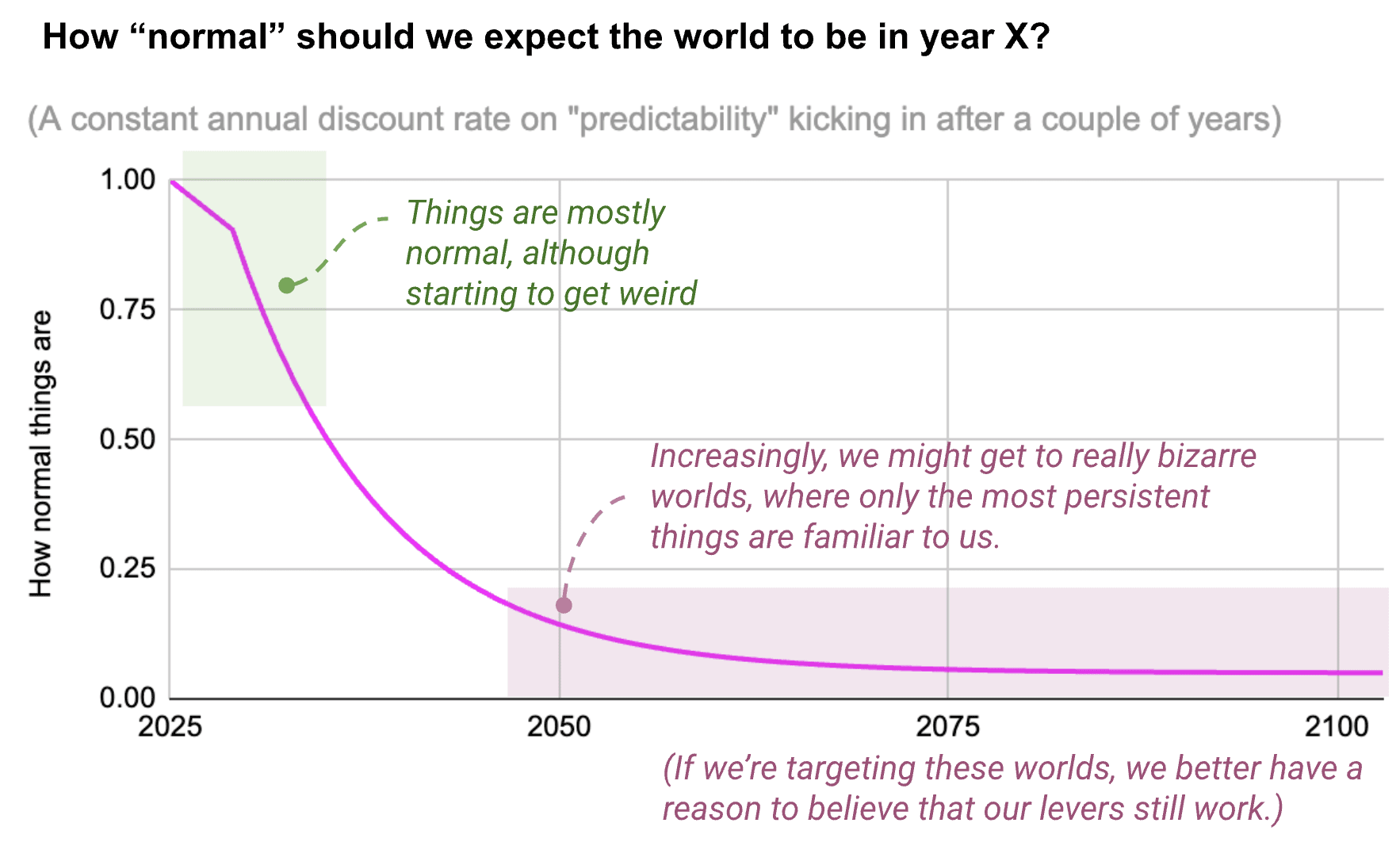
Should we be aiming to improve animal welfare in the long-run future (in transformed eras)?
We can’t expect (without justification) that the same strategies will work for helping animals before and after a “paradigm shift.”[8] So we think it’s worth splitting strategies by the "kind of world" they try to affect:
- The “pre-paradigm-shift” or “normal(ish) era”, where we can mostly imagine today’s world, with some adjustments based on specific trends or developments we can already foresee
- The “post-paradigm-shift” or “transformed era”, which looks extremely alien to us, as AI (or other things) have upended almost everything
Some people are pessimistic about the viability of trying to reach across these eras and predictably affect what’s happening in the “transformed” world. On this view, we’re pretty “clueless” about how to help animals past a certain point in time, and should just focus on “normal” worlds if we want to help animals.
But if we could actually find levers that reach across the paradigm shift, then we may be able to have an outsized impact. In particular, we may be able to identify more robust trends (“pockets of predictability”) or pivotal transition points (~crucibles) whose outcomes are contingent, persistent, and predictably good or bad for animals.
Ultimately, we think that right now, we don’t know of strong strategies/levers that reach across paradigm shifts, but that some work should go to looking for such strategies (and that occasional high-leverage opportunities may show up, particularly for people in unusual positions — so they’re worth paying attention to).
Here are some of our considerations:
What era is targeted | Normal(ish) (pre-shift) era | Transformed (post-shift) era (/ the long-term future) |
Sketch of the strategies involved | Pursue interventions that will pay out before the critical shift.
(And as the world starts changing, we’ll know more about what to expect further out.) | Look
for interventions whose effects will persist into the “post-shift” era
(or otherwise affect the longer-term future in predictable ways)[11]. |
Key things to remember about these strategies | We should heavily discount the impact of these interventions over time to account for the probability that the world changes and the intervention’s theory of change is disrupted. (See below.) | We should only pursue strategies that are particularly robust — we have specific reasons to believe they’ll be positive across many different worlds, or the “transformed” worlds we expect.
(One way to approach this is to look for AW-relevant “basins of attraction”[12] / “lock-ins” that will persist past the paradigm shift, which we’d be able to steer into or around.) |
Reasons to penalize our estimates for how promising targeting this era/paradigm would be | These
interventions will have less time to pay out (we’re not filtering them
for cross-paradigm robustness, so we can’t assume that they’ll stay
relevant once AI starts radically transforming the world). Targeting
normal(ish) worlds may functionally involve betting on longer AI
timelines (or on “AI will not actually be that transformative”[13]).
The
period/scenarios in which this world is relevant may also have weaker
levers for actually help animals. (For example, you may think that
advanced AI could be a very powerful lever for scaling AW work — but
you’re conditioning on “AI isn’t a big deal.” Or you may think
that most worlds in which AI development stalls involve a large-scale
nuclear war that derails scientific progress — and a large-scale nuclear
war may also derail animal advocacy efforts.) | It’ll
be harder to be confident that these strategies will be relevant, or
that their impact will be positive (we may just be totally off!). This
should be viewed as a real penalty on their viability.
It’s also possible that AW problems will be solved (or overdetermined) “by default” in most transformed worlds[14] (which would be a penalty on the scope of these strategies). |
Reasons to pursue interventions that target this era | • It’s
possible that things will remain normal for a reasonably long time, for
instance because AI progress slows down — or because advanced AI
systems just don’t change the world very much
• We have more evidence of interventions like this actually working | • We
may find unusually powerful opportunities to prevent the development
& normalization of new kinds of animal-related catastrophes
(“trajectory change”)
◦ (This is probably our top recommendation for further research in this space)
• The
~number of animals such interventions could help might be huge
(although this is trickier to reason about than might appear — see below) |
~Random examples as illustrations | • Use AI to boost (standard) farmed animal advocacy
• Invest in “welfare-improving PLF” | • Explore
how harmful animal practices may get “locked in” artificially via
transformative AI & try to prevent that from happening
• [Maybe]
Encourage AI companies to use “sentient beings” (instead of “humans”)
in certain places in their AI training/”constitutions” |
It’s also possible that the most promising scenarios to target are actually somewhere in between the two options above — e.g. worlds in which AI is “a huge deal, but not utterly transformative” (more like the internet). These could provide us with strong levers (new tech opportunities, maybe large amounts of funding) while being predictable-enough to plan for (and might retain status-quo issues, unfortunately). On the other hand they may be fairly unlikely, or actually sufficiently bizarre... (For now, we’re just listing this as a question to consider exploring.)
A Note on Pascalian Wagers
A possible defense of investing in certain speculative long-run-future-oriented interventions goes like this:
Because the stakes of the post-paradigm-shift world might be so high, even small increases in the probability of better outcomes can outweigh the value of pre-paradigm-shift, more certain work.
In our specific context, this might become:
Giving some of today's AI models a strong stance against factory farming is unlikely to help the long-run future much (even if we manage to do it) — it's unclear if there will be factory farming in the future [see below], or if today's model values will translate to future models' [see below], ... — but if there *are* factory farms, there could be *so many* of them. So even with the reduced chances, it's worth investing in.
We disagree with this stance, and only consider a possible intervention for affecting the post-paradigm-shift world when we have a concrete, articulable reason why it should predictably affect that world. In particular, we think that the uncertainty in most interventions' expected effects builds up incredibly quickly when we're talking about post-paradigm worlds, and it's basically just as easy for the effects of such interventions to be negative — as one example, see the discussion on how making AI values “animal-friendly” may backfire, below. So you really do need a specific reason to believe in your levers.
Perhaps unsurprisingly, this dynamic tends to make us more skeptical of many (consequentialist) interventions that are justified on the basis of helping animals in the long-term future (or in "post-transformation" scenarios).
(But this is a well worn topic, and we won’t discuss it further in the memo.)
Discounting for obsoletion & the value of "normal-world-targeting" interventions given a coming paradigm shift
These considerations affect how we think about normal interventions, too:
- In general, most of the “levers” which exist and work pre-paradigm-shift (now) do not obviously work post-paradigm-shift (the levers will break, the changes they cause will not translate directly). As discussed above, we think this means you should heavily discount the effects of using most levers (based on when you expect the world to be transformed).
- When considering the levers advocates currently pursue (e.g. cage-free campaigns), we don’t immediately see reasons for why these levers' effects would persist post-paradigm-shift.
- For example, it seems extremely unclear that McDonald’s would continue to honor a pledge about cage-free eggs once the economy had been radically transformed, human labor was no longer economically valuable, etc. (“MacDonald’s” might no longer exist. Even eggs, cages, etc. might at some point become obsolete. ...)
- So we think that, unless advocates have a specific & compelling story for why a lever’s outcomes will persist post-paradigm-shift, they should only focus on the effects the intervention will have before the paradigm shift, and discount the post-shift impacts to ~0.
- For example, if you believe that McDonald’s will honor cage-free eggs pledges for only the next 10 years, you should only consider suffering averted within the next decade.
- We’re not actually sure how quickly things will change, so we can model this as some (annual) penalty on the expected impact of a given intervention that accounts for the chances that the intervention has become obsolete by time x
- As an example of why this matters: Cost-effectiveness of Anima International Poland discounts the impact of commitments via a “Probability that commitments are relevant” curve (shown in blue below), resulting in a median estimate of 37 years of "relevancy". An alternative discount schedule, which we think better accounts for the impact of AI (though think is oversimplified and don’t strongly endorse), results in a median of only 9 years of "relevancy" (see the red curve).

- We fairly strongly feel that this kind of discounting is worth doing — even with something as simple as the “10% per year” model above — though are unsure how much such discounting would change priorities for AW advocates
§2.2 Exploring wild animal welfare & not over-indexing on farming
We think it’s likely that animals as we know them will at some point stop being economically valuable, and don't expect a huge number of farmed animals in our central examples of an "(AI-)transformed world". Just as oxen were replaced by tractors and messenger pigeons by the telegraph, we expect farmed animals to be outcompeted by some (perhaps unknown-to-us-today) technology.
So we recommend trying to not index on our current world, where factory farming is arguably the greatest source of animal suffering, at least as far as we can easily affect it.
The stories we can tell for why a post-paradigm-shift world would include animals generally rely on some sort of sentimentality. This probably means that wild animal suffering is the most likely source of animal suffering in post-paradigm-shift worlds (because decision-makers have sentimental attachment to nature/wild animals, or moral views on this question) — we therefore tentatively suggest that most AW work targeting post-paradigm-shift worlds should focus on wild animals (or more generally animals that exist for non-”functional” reasons).
(Still, we can't rule out farming. "Nostalgia" and other factors could lead to the persistence of farming, we might see new “functional” animals or animal practices, and there are unknown unknowns here. We note related questions in the list below.)
Further readings (optional)
Key organizations
Improving the long-term future
Effective Altruism (EA)
A philosophical and social movement that uses evidence and reason to determine the most effective ways to benefit others, often focusing on issues that are great in scale, severely neglected, and highly tractable (solvable).
A research nonprofit focused on how to navigate the transition to a world with superintelligent AI systems.
A non-profit “think-and-do tank” that provides foundational analysis and data across several major cause areas, including influential work on estimating the scale and nature of wild animal suffering.
Wild animal welfare
An international organization dedicated to raising awareness and promoting research into the situation of wild animals and how to help them, as well as addressing other highly neglected areas of animal advocacy.Check out their resource library on wild animal suffering, as well as short videos published on YouTube.
A nonprofit addressing the most pressing scientific research gaps in wild animal welfare. WAI is one of only four organizations to receive Animal Charity Evaluators’ highest rating, and the only one to focus on wild animals.Check out their extensive resource library including peer-reviewed articles on wild animal welfare.
Reducing suffering in the long-term future
Centre for Reducing Suffering (CRS)
A research center founded by Tobias Baumann and Magnus Vinding that researches how to best reduce suffering (rather than maximize happiness), considering all sentient beings and the longterm future.
Center on Long-Term Risk (CLR)
A research institute that investigates ways to encourage cooperation and avoid conflict dynamics between powerful AIs in order to mitigate worst-case risks.
A nonprofit making grants and investments with a focus on reducing catastrophic AI misuse, promoting cooperation and avoiding conflict, and advancing AI welfare.
Longtermism and animals
Fin Moorhouse (2021) | see especially § Objections and § Going further
§ Objections of this article published by the Center for Effective Altruism summarises five standard critiques of longtermism (see below), and concludes with a list of resources for further reading.
- Person-affecting views: Disputes the core idea that creating trillions of happy future lives is a moral good, because an act can only be beneficial if it improves the life of an actual (not hypothetical) individual.
- Risk aversion & recklessness: It is reckless to act on mathematically high “expected value” (low probability × huge payoff), especially when the chance of success for complex, long-term interventions is highly uncertain and near-zero.
- Demandingness: Longtermist implies unreasonably large sacrifices for hypothetical future beings.
- Uncertainty: It is difficult to reliably predict the long-term consequences of our actions. Accordingly, it is difficult to distinguish between targeted interventions which are too speculative, and those that are actually robustly beneficial.
- Political risks: The “high stakes” framing of longtermism could be exploited to detract from urgent present-day issues or justify political harms in the service of a utopian future.
Varieties of Longtermism and Things 80,000 Hours Might Be Getting Wrong
Benjamin Todd, Arden Koehler, Robert Wiblin and Keiran Harris | see especially § Varieties of longtermism and § Implications for different types of longtermists (3:55-33:06)
The selected portions of this interview on the 80,000 Hours podcast compare and contrast four major longtermist schools of thought.
The remaining readings turn an animal lens on longtermism.
See this topic page on the EA Forum for more on non-humans & the long-term future.
Animals and Longtermism: A Guide for the Perplexed Pt. 2 (below)
Oscar Horta (2025) | 15 min talk
In this short talk, philosopher Oscar Horta argues that longtermism must be reframed to include animals. He stresses that emerging technologies (e.g. AI, synthetic biology) pose major, neglected risks for wild and exploited animals, making animal advocacy an urgent, high-leverage cause for the long term.
Longtermism in Animal Advocacy (below)
Zach Freitas-Groff (2021) | 1h17 min talk
In this talk, Zach Freitas-Groff sketches a longtermist advocacy agenda centered on high-leverage interventions (e.g. institutional change, moral circle expansion) that create persistent effects over centuries. This effort necessitates empirical analysis from fields like economic history to identify the societal levers that truly influence future moral and policy trajectories.
Wild animal welfare
What 99% of people don't know about Wild Animals (above)
Jack Hancock-Fairs (2024) | 33 min talk
This talk by advocate and filmmaker Jack Hancock-Fairs offers an excellent overview of wild animal welfare as a cause area.See more of Jack Hancock-Fairs’ discussions on wild animal suffering here.
Wild animal welfare: Assessing the situation
How Many Wild Animals Are There?
Brian Tomasik (2019)
This essay by suffering-focused thinker Brian Tomasik attempts to estimate the number of currently existing wild animals.See more of Brian Tomasik’s writings on wild animal suffering here.
How Wild Animals Die: What We Know So Far
Luke Hecht (2020)
This report published by Wild Animal Initiative takes a scientific look at how animals die in nature.See also the other publications in this series Why Cause of Death Matters for Wild Animal Welfare and Methods for Studying Wild Animals’ Causes of Death.
Heather Browning & Walter Veit (2023)
This academic article by philosophers of animal sentience Heather Browning and Walter Veit challenges the common assumption that suffering dominates the lives of wild animals, arguing that this view warrants a stronger empirical foundation.The authors propose that instead of trading intuitions about positive versus negative wild lives, the priority should be developing robust scientific methods and data collection to accurately measure and determine the true scope of wild animal suffering.
Other resources
Wild Animal Suffering and the Importance of the Future (above)
Animal Ethics (2020) | 7 min video; audio available
This video is part of a course on wild animal suffering created by the organization Animal Ethics.
Précis of Wild Animal Ethics (available open-access here)
Kyle Johannsen (2022)
Short chapter-by-chapter summary of Kyle Johannsen’s 2020 book Wild Animal Ethics: The Moral and Political Problem of Wild Animal Suffering.
Panspermia and space
Panspermia is the spread of life across space. Directed panspermia is the intentional spreading of life across space (e.g. “seeding”, as opposed to non-intentional spreading, as when life is transported by interstellar debris).
A Crashed Israeli Lunar Lander Spilled Tardigrades on the Moon
Daniel Oberhaus (2019)
In 2019, an Israeli lunar lander, carrying thousands of tardigrades (water bears), DNA samples, and books, crashed onto the Moon, just moments before its scheduled soft landing.The lander failed to make contact with mission control seconds before impact, leaving the fate of the tardigrades – highly robust multicellular organisms – uncertain following the high-speed crash.
Space Station Mold Survives High Doses of Ionizing Radiation
Marta Cortesão (2019)
This press release summarizes research findings suggesting that certain mold species can survive large exposures to radiation in space. It touches on some potential motivations for bringing mold into space (e.g. to produce antibiotics, nutrients, useful biomaterials).
On Terraforming, Wild Animal Suffering, and the Far Future
Michael Dello-Iacovo (2016)
This essay by Michael Dello-Iacovo provides an overview of the intersection between wild animal suffering, terraforming, and the long-term future.
Will Space Colonization Multiply Wild-Animal Suffering?
Brian Tomasik (2018)
Futurists propose spreading life through space colonization and terraforming (like Mars). But is it ethically permissible to create new ecosystems dominated by Darwinian suffering?See also Brian Tomasik’s video commentary on this topic.
To Seed or Not to Seed: Estimating the Ethical Value of Directed Panspermia
Asher Soryl & Anders Sandberg (2025) | 10 min read
A short introduction to the concepts of “directed panspermia” (intentionally seeding other planets with life – an action which may be feasible within a matter of years, with potentially extreme ethical implications) and “cosmic rescue missions” (future interventions to relieve the wild suffering that likely already exists beyond Earth).
Darwinian Hellworlds and Cosmic Rescue Missions (below)
David Pearce (2025) | 26 min talk
David Pearce characterises “Darwinian Hellworlds” where biological suffering prevails, and proposes the idea of “cosmic rescue missions” to alleviate suffering in those worlds.
Uncertainty and cluelessness
What to do about near-term cluelessness in animal welfare
Anthony DiGiovanni (2025) | 18 min read (31 min audio available)
In this EA Forum post, Anthony DiGiovanni, a researcher at the Center on Long-Term Risk, argues that even near-term animal welfare work is subject to significant uncertainty. This post also outlines specific backfire risks in advocacy work, including inadvertently increasing populations of wild animals with net-negative lives or substituting consumption of larger animals with (a greater number of) smaller animals.
Evidence, Cluelessness, and the Long-Term (below)
Hilary Greaves (2020)
Philosopher Hilary Greaves argues that while evidence is crucial for evaluating near-term effectiveness, it is ultimately insufficient for guiding major moral decisions. The speaker contends that the unmeasured, far-future effects of any action dominate the expected moral value, generating a paralyzing sense of cluelessness that is best resolved by pivoting toward longtermism and interventions aimed explicitly at securing the very far future.
Cluelessness (available open-access here)
Hilary Greaves (2016)
In this academic paper, Hilary Greaves coins the term "cluelessness”. She distinguishes between simple and complex problems of cluelessness. While the simple problem is resolved because the countless long-term ripple effects of small actions are likely to statistically cancel out, the complex problem remains a genuine threat because systematic, competing arguments about an action's true long-term value cannot be reconciled.
Moral Decision-Making Under Uncertainty
Christian Tarsney, Teruji Thomas, and William MacAskill (2024)
A comprehensive article in the Stanford Encyclopedia of Philosophy.
Maximal Cluelessness (available open-access here)
Andreas L. Mogensen (2021)
This report published by the Global Priorities Institute argues that a rational agent's decisions must be based on highly uncertain, long-term impacts, not predictable near-term results. The core insight is that because the decisive factor is the unknown risk of future catastrophe, a rational agent is not strictly required to follow evidence-based prioritization, as tiny, unprovable shifts in existential risk dominate the expected moral value.
Hilary Greaves, Robert Wiblin, and Keiran Harris (2018) | 2h50m interview
In this interview on the 80,000 Hours podcast, Hilary Greaves challenges foundational decision theory and applies these critiques to resolve the problem of cluelessness in altruistic decisionmaking. She speaks about her work at GPI building the academic rigor for longtermism, including formally debating discounting future welfare, solving population ethics, and integrating economic tools like weighted cost-benefit analysis into moral philosophy.
Welcome to the Future Nauseous
Venkatesh Rao (2012)
This blog post probes the uncanny interface between our mundane present and the fundamental alien-ness of the future.
Wild animal welfare: Doubts and uncertainties
Wild Animal Suffering is Intractable (available open access here)
Nicolas Delon & Duncan Purves (2018)
This paper contends that large-scale technological interventions to reduce wild animal suffering are highly intractable due to epistemic hurdles: the inability to reliably predict cascading effects in complex, indeterminate ecological systems.They contend that interventions are morally problematic because they require actively doing harm, and given the high uncertainty, we are currently not justified in thinking they will reduce total suffering, advocating instead for small-scale, adaptive management.
Why Most People Don't Care About Wild-Animal Suffering
Ben Davidow (2013)
This short piece examines intuitions preventing broader concern for wild animals, such as status-quo bias, just-world hypothesis, and lack of intentional harm.
Ten Biases Against Prioritizing Wild-Animal Suffering
Magnus Vinding (2020)
This blog post confronts major biases underwriting lack of concern for the suffering of wild animals:
- Historical momentum and the status quo
- Emotionally salient footage
- Perpetrator bias
- Omission bias
- Scope neglect
- Invertebrate neglect
- Thinking we can have no impact
- Underestimating public receptivity
- Overlooking likely future trajectories
- Long-term nebulousness bias
Why I No Longer Prioritize Wild Animal Welfare
Saulius Šimčikas (2023)
This forum post charts a skeptic's journey, concluding that wild animal welfare is currently a low-priority cause due to overwhelming short-term tractability issues (farmed animals are more cost-effective) and long-term scale concerns (the suffering of future digital minds presents a larger risk).The author argues that while lobbying for wild animal welfare or pursuing cosmic expansion is highly speculative and subject to cluelessness, current funding levels should be maintained (though not significantly increased) as a low-cost hedge against cluelessness to explore entirely new avenues for future impact.
To Assist or Not to Assist? Assessing the Potential Moral Costs of Humanitarian Intervention in Nature (available open-access here)
Kyle Johannsen (2020)
This philosophical paper argues that while intentional habitat destruction to prevent wild animal reproduction is morally wrong (as negative duties are more stringent than positive duties), cautious intervention is still justified.The author contends that the risk of unintended harm should not lead to “paralysis”, as the potential benefits of cautiously assisting wild animals outweigh the excusability of accidental, unforeseeable negative outcomes.
Should We Interfere with Wild Nature to Reduce Suffering?
Peter Godfrey-Smith, Luisa Rodriguez, and Keiran Harris (2024) | see especially § Wild animal suffering and rewilding (00:04:09+)
A critical discussion on wild animal suffering with philosopher of science Peter Godfrey-Smith, author of Other Minds: The Octopus, the Sea, and the Deep Origins of Consciousness and Metazoa: Animal Life and the Birth of the Mind.
Lock-in, backfire risks, and more
Long-term planning is fraught with many other hazards apart from uncertainty. These resources expand on the concept of lock-in: developments which forever close the door to certain future possibilities.
Alfie Lamerton (2025)
This LessWrong post provides a short overview of the concept of lock-in.See also Lock-in Threat Models, as well as other posts by Alfie Lamerton on lock-in.
Goldstein et al (2023) | see especially §1 Introduction
Originally coined in the context of carbon dependence, the concept of lock-in has since been applied to conceptualise risks across economics, sociology, political science, rural development, AI safety, and many other domains. The introduction of this academic article provides a brief history of the concept of lock-in and the related notion of path dependency.“How do we know if we are “locked-in” and how might locked-in dynamics ultimately be disrupted? Is lock-in ever a good thing, or is it always a case of intractable sub-optimal conditions? What criteria and whose perspectives determine which outcomes are sub-optimal? At what scale(s) can and should lock-in be assessed: is it always most pertinent to global scale infrastructure, such as for fossil fuels, or can the theoretical concept be applied to explain more localized empirical phenomena? Can something be locked-in at one scale but not at another?”
Moral Circle Expansion Might Increase Future Suffering
Magnus Vinding (2018) | 5 min read
Moral circle expansion involves extending the scope of moral consideration, as exemplified by the increasing historical inclusion of minorities (women, ethnic minorities, LGBTQ+, nonhuman animals, nature…).On the face of it, moral circle expansion seems to be clearly a good thing. What could go wrong? Magnus Vinding explores ways in which moral circle expansion may backfire, instead harming animals and other beings.
Counterproductive Altruism: The Other Heavy Tail (available open-access here)
Daniel Kokotajlo & Alexandra Oprea (2020)
This paper advocates for the “heavy tail hypothesis”, according to which the effectiveness of altruistic interventions follows a distribution where the best options are vastly superior to the average. It provides empirical and analogical evidence (e.g. in public health and venture capital) for this heavy right tail.The authors then argue that the existence of this huge potential for good implies an equally heavy left tail of interventions that are massively counterproductive or harmful, underwriting the need for a “do no harm” framework to avoid catastrophic backfire risks.
See the EA Forum linkpost for discussion of this article.
Taking action
Research vs. Non-Research Work to Improve the World: In Defense of More Research and Reflection
Magnus Vinding (2022)
This blog post by suffering-focused thinker Magnus Vinding contrasts research vs. action for long-term impact.
Taking action to reduce wild animal suffering
Humanitarian Assistance for Wild Animals (available open-access here)
Kyle Johannsen (2021)
This short article by Kyle Johannsen, author of Wild Animal Ethics: The Moral and Political Problem of Wild Animal Suffering, establishes the evolutionary R-strategy (producing numerous offspring where most die painfully) as the core mechanism of pervasive wild animal sufferingJohannsen proposes that this immense, unmitigated suffering calls for large-scale, high-tech interventions such as developing genetic painkillers for R-strategist infants, arguing that the astronomical benefits outweigh risks, naturalness objections, and the harms of necessary experimentation.
What to Do – If Anything – about Wild Animal Suffering
Persis Eskander (2019) | 3 hour interview
In this interview, Persis Eskander, researcher at Open Philanthropy and cofounder of Wild Animal Suffering Research (now Wild Animal Initiative), argues that although the scale of wild animal welfare is immense, farmed animal welfare is currently more tractable because wild animal welfare lacks research and safe, cost-effective interventions. However, she advocates maintaining funding for wild animal welfare as a strategic investment in academic field-building and shaping long-term moral values to ensure future generations can safely intervene on a large scale.
Dismantling the Myth that We Can't Do Anything to Help Wild Animals
Cameron Meyer Shorb, Luisa Rodriguez, Keiran Harris, & Katy Moore (2024) | see especially § Can we even help wild animals without unintended consequences?
In this interview segment, Cameron Meyer Shorb, Executive Director of Wild Animal Initiative, argues that the tractability barrier is overcome not by radical action, but by rigorous science and strategic design. He explains that while large interventions risk complex trophic cascades, success lies in fieldbuilding, developing reversible interventions (like contraception and vaccines), and testing robust solutions (e.g. selective reforestation and humane fire management).
Reducing Wild Animal Suffering Effectively: Why Impracticability and Normative Objections Fail Against the Most Promising Ways of Helping Wild Animals (available open access here)
Oscar Horta & Dayron Teran (2023)
Two major objections to intervening in wild animal suffering appeal to impracticality (e.g. uncertainty/cluelessness, risk) and normativity (e.g. naturalness, holism). The authors of this article contend that these objections fail against current and near-term interventions, such as wild wild animal vaccination, assisting animals in extreme weather, and urban welfare programs – many of which are feasible now.
Wild Animal Welfare in the Far Future
Saulius Šimčikas (2022) | 5 min read (§ Summary only); 4 min audio available (0:00-3:50)
This EA Forum post argues that, despite significant uncertainty about long-term outcomes, there may be some conservative actions we can take today to improve the welfare of wild animals in the future.
Persistence and Reversibility: Long-Term Design Considerations for Wild Animal Welfare Interventions
Simon Eckerström Liedholm (2019)
This report written by a researcher at Wild Animal Initiative advances persistence and reversibility as guiding principles for interventions into wild animal suffering.Access the full report here.
Reducing aquatic noise as a wild animal welfare intervention
Saulius Šimčikas | 35 min read
Ships, drilling, & other human activities create significant noise pollution in the ocean, disrupting the lives and natural behaviors of many marine animals, such as whales. This EA Forum post calls for aquatic noise reduction as an intervention for ameliorating wild animal suffering.What If We Understood What Animals are Saying? The Legal Impact of AI-assisted Studies of Animal Communication in week 4’s further readings appendix also discusses aquatic noise pollution as an agenda for interspecies communication.
Nature without Suffering: Herbivorisation of Predator Species for the Compassionate Stewardship of Earth’s Ecosystems (available open access here) Stijn Bruers et al (2024)
This academic article advances the conversion of predators into herbivores as a promising approach to reducing wild animal suffering.
Should Longtermists Recommend Hastening Extinction Rather Than Delaying It?
Richard Pettigrew (2024)
This paper presents a formal challenge to the utilitarian foundation of longtermism, arguing that choosing to maximize expected utility or expected value fails to account for an agents’ attitudes toward risk and often leads to counterintuitive moral outcomes. Case in point: the author shows that if moral choice requires a risk-averse decision theory, it leads to the robust, but alarming, conclusion that one should prioritize hastening human extinction over securing a long, happy future, forcing a reconsideration of how risk figures in moral philosophy.
Do We Have a Moral Obligation to Abolish Wilderness?
Joshua Duclos (2023)
In this article, philosopher Joshua Duclos, author of Wildnerness, Morality, and Value, argues that because life in the wilderness entails vast, undeserved, and non-beneficial suffering (e.g. predation, disease, starvation), humans have a strong moral reason to intervene in nature to diminish or eliminate the conditions that create this suffering, reaching conclusions directly opposed to conservationism.
S-risks: Risks of astronomical suffering
S-Risks: Fates Worse Than Extinction (below)
Rational Animations | 10 min video
This short video introduces the concept of S-risks: risks of “astronomical” suffering.
Pre-session exercises
Please spend 20-30 minutes completing these two exercises.
- You can write your responses in bullet point format if that’s easier.
- Submit your responses in the weekly Slack thread created by your facilitator in your channel at least 24 hours before your regularly scheduled meeting.
- Leave at least one comment on somebody else’s response.
The case for and against longtermism
[150 words] Longtermism holds that positively influencing the far future (the next 500, 1,000, or even 10,000+ years) is a, if not the, defining moral priority of our time.
First, review the basic argument for longtermism:
- Moral status: The lives and suffering of future people and animals matter just as much as those alive today.
- Numbers: The number of future people and animals who could exist is vastly larger than the number of beings alive now.
- Unique leverage: Due to our special place in history, our actions could significantly influence their lives for the better or for the worse.
- Priority: If (1-3) are true, then positively influencing the far future should be our moral priority.
∴ Conclusion: Positively influencing the far future should be our moral priority.
Your task is to analyze this argument:
- Which specific premise (i-iv) do you find the most compelling or well-supported?
- Which do you find the most questionable or dubious?
- Which crucial considerations, if any, might be missing?
Explain your reasoning, making reference to key concepts (e.g. scope-sensitivity, lock-in, uncertainty/cluelessness, backfire risks, etc.) where relevant.
The case for and against wild animal welfare
[150 words] Predation, disease, starvation, and environmental exposure: it would seem that suffering prevails in the wild. Should the welfare of wild animals be a priority for advocates?
First, review the basic argument for wild animal welfare:
- Moral status: The lives and suffering of wild animals matter.
- Numbers: There are many more wild animals than domestic (including farmed) animals.
- Suffering: The vast majority of lives of wild animals are short and dominated by suffering which is often severe in nature (e.g. due to disease, predation, etc.).
- Tractability: There are some actions we can take to safely and effectively mitigate wild animal suffering.
- Priority: If (1-4) are true, then wild animal welfare should be a critical priority for advocates.
∴ Conclusion: Wild animal welfare should be a critical priority for advocates.
Your task is to analyze this argument:
- Which specific premise (i-v) do you find the most compelling or well-supported?
- Which do you find the most questionable or dubious?
Explain your reasoning, making reference to key concepts (e.g. scope-sensitivity, causes of suffering, uncertainty/cluelessness, backfire risks, etc.) where relevant.


